If you’ve ever stumbled across the word Goetia and felt a pull toward it — a mix of curiosity and something harder to name — you’re not alone. The Ars Goetia is one of the most compelling and misunderstood systems in the Western occult tradition. It’s ancient, structured, and far more nuanced than the horror-movie version most people have in their heads.
This is your beginner’s map. By the end, you’ll understand what the 72 Goetic spirits actually are, how they’re organized, what they can do, and how practitioners work with them through sigils and ritual.
What Is the Ars Goetia?
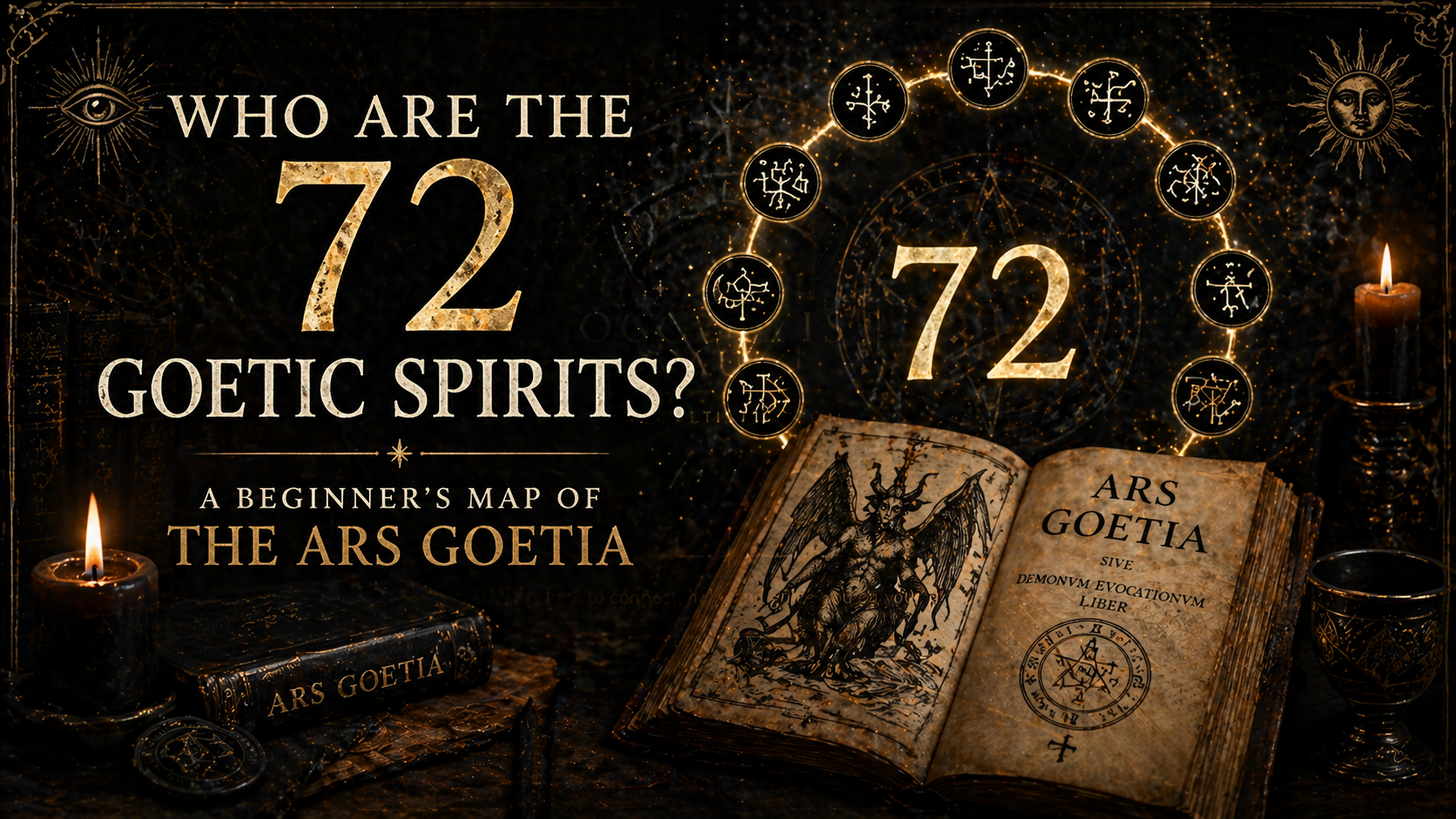
The Ars Goetia is the first section of a 17th-century grimoire called The Lesser Key of Solomon (also known as the Lemegeton). It catalogues 72 spirits — often called demons, though that word carries modern baggage the original text doesn’t quite intend — along with their ranks, abilities, seals, and the methods used to call upon them.
The system didn’t appear from nowhere. It draws on centuries of Jewish, Arabic, and Christian demonological tradition, filtered through Renaissance ceremonial magic. By the time it was compiled into its current form, it had become something remarkably systematic: a directory of non-human intelligences, each with a specific nature, a specific purpose, and a specific seal.
That seal — the sigil — is the key to everything.
The Hierarchy: Ranks and What They Mean
The 72 spirits are not equals. They’re organized into a clear hierarchy of military-style ranks, which tells you something important about how the medieval and Renaissance mind understood spiritual power — as a kind of invisible court or army, mirroring earthly kingdoms.
Here are the main ranks you’ll encounter:
Kings — The most powerful class. There are 4 Kings among the 72 (Bael, Paimon, Beleth, Purson, and others), each ruling over a vast number of lesser spirits. They command legions and demand considerable respect in ritual.
Dukes — The largest single class in the Goetia. Dukes tend to govern natural forces, emotions, knowledge, and transformation. Astaroth, Agares, and Valefor are among the most well-known.
Princes and Prelates — Governing specific domains of influence, Princes like Sitri or Ipos often deal with desire, wit, and hidden knowledge.
Marquises — Associated with time, the dead, and secret arts. Marquises like Samigina and Amon often have connections to past lives and ancestral wisdom.
Earls (Counts) — Spirits of a more earthly, practical nature. They govern things like familiars, nature spirits, and battle.
Knights — The rarest rank in the Goetia, with only a handful of spirits holding this title.
Each rank carries a different flavor of energy and a different protocol for working. This isn’t just ceremonial detail — understanding rank helps a practitioner approach each spirit with appropriate intention and structure.
The Domains: What Do They Actually Do?
This is where things get genuinely fascinating. The 72 spirits collectively cover an enormous range of human concerns. The Goetia reads, at times, like an ancient Yellow Pages for the soul.
Among the 72, you’ll find spirits that govern:
- Knowledge and wisdom — teaching sciences, philosophy, languages, and hidden arts
- Love and desire — drawing affection, influencing emotions, revealing the feelings of others
- Wealth and material power — bringing treasure, securing favor, advancing careers
- Protection and warfare — defending the practitioner, commanding spiritual armies
- Divination — revealing the past, present, and future; exposing secrets
- Transformation — changing circumstances, habits, the inner self
- The dead and ancestral knowledge — communicating with the departed, accessing ancient wisdom
This range is one reason the Goetia has remained relevant across centuries. Whatever a practitioner is working on — healing, ambition, creativity, protection — there is almost certainly a spirit within the 72 whose domain touches it.
The Sigil: The Spirit’s Signature
Every one of the 72 spirits has a unique sigil — a geometric seal that functions as the spirit’s personal signature and point of contact. In practice, the sigil is the single most important tool in Goetic work.
Think of it this way: a spirit’s name is how you refer to it in language. The sigil is how you reach it directly.
Sigils are used in ritual as a focal point — drawn, traced, or gazed upon during invocation. They appear on parchment, talismans, and altar cloths. Some practitioners work with a spirit’s sigil during meditation before any formal ritual, building a relationship with the energy before making a direct request.
The visual language of the sigils is striking. Each one is distinct, often combining curved lines, crosses, and angular elements in a way that feels intentional and alive. Spend time with them and you’ll understand why practitioners say the seals carry something of the spirit within them.
If you want to work seriously with the sigils, having all 72 in one dedicated reference is essential — which is exactly what the Summoning the 72: Complete Goetic Sigil Workbook is built for. It includes all 72 seals alongside their correspondences and dedicated record pages for tracking your workings.
A Few Spirits Worth Knowing
You don’t need to memorize all 72 at once. But getting to know a handful of the most widely studied spirits gives you a feel for the system’s range and depth.
Bael — The first spirit listed, a King commanding 66 legions. He grants invisibility and cunning. His appearance shifts between forms: a man, a cat, a toad, or all three at once.
Paimon — A King of the West, riding a camel, accompanied by the sound of trumpets. He teaches arts, sciences, and the secrets of the earth. One of the most communicative spirits in the Goetia.
Astaroth — A Duke of great power, often depicted riding a dragon. He reveals hidden truths, teaches liberal sciences, and has knowledge of the past, present, and future. Approach with appropriate respect and protection.
Marbas — A President governing 36 legions. He reveals hidden things, grants mechanical knowledge, and — notably — can cause and cure diseases.
Sitri — A Prince who inflames love and causes people to show themselves naked. Governs 60 legions and is often depicted as a leopard-headed figure with griffin wings.
Each of these spirits has layers. The more you study them, the more you realize the Goetia is not a list of monsters — it’s a taxonomy of forces, each with its own intelligence, domain, and way of operating.
Is the Goetia Dangerous?
This question comes up constantly, and it deserves a direct answer: the Goetia requires respect, structure, and preparation. It is not a casual system. The original texts are full of protective mechanisms — circles, triangles of manifestation, holy names, banishing procedures — because the magicians who wrote them understood that working with powerful non-human intelligences demands boundaries and clarity of intent.
That said, fear-based avoidance serves no one. Thousands of practitioners work with Goetic spirits safely and with meaningful results. The key is knowledge before action — understanding the system before stepping into ritual.
That’s exactly the gap that The Goetic Beginner’s Grimoire is designed to close. It walks you through all 72 spirits, the rituals used to work with them, and — critically — safe practice protocols so your first steps into Goetic work are grounded and protected.
How to Begin
If the Ars Goetia is calling to you, the worst thing you can do is either dive in blindly or talk yourself out of it entirely. The right move is to learn the system properly — the hierarchy, the spirits, the sigils, the ritual structure — and then work with that knowledge consciously.
Start with study. Read about the 72. Learn the ranks. Get familiar with the sigils. Understand what each spirit governs and how practitioners have approached them historically.
Then, when you’re ready to move from reading to practice, you’ll want dedicated tools:
- The Goetic Beginner’s Grimoire — for structured, safe ritual guidance across all 72 spirits ($17)
- Summoning the 72: Complete Goetic Sigil Workbook — for all 72 seals, their correspondences, and record pages to document your workings ($27)
The Ars Goetia has endured for centuries because it works — as a system of symbolic intelligence, as a map of the mind’s deeper forces, and as a genuine tradition of spirit contact. Whatever draws you to it, the path begins with understanding.
The 72 are waiting.
Occultist101 — The Hidden System of Modern Occult Practice