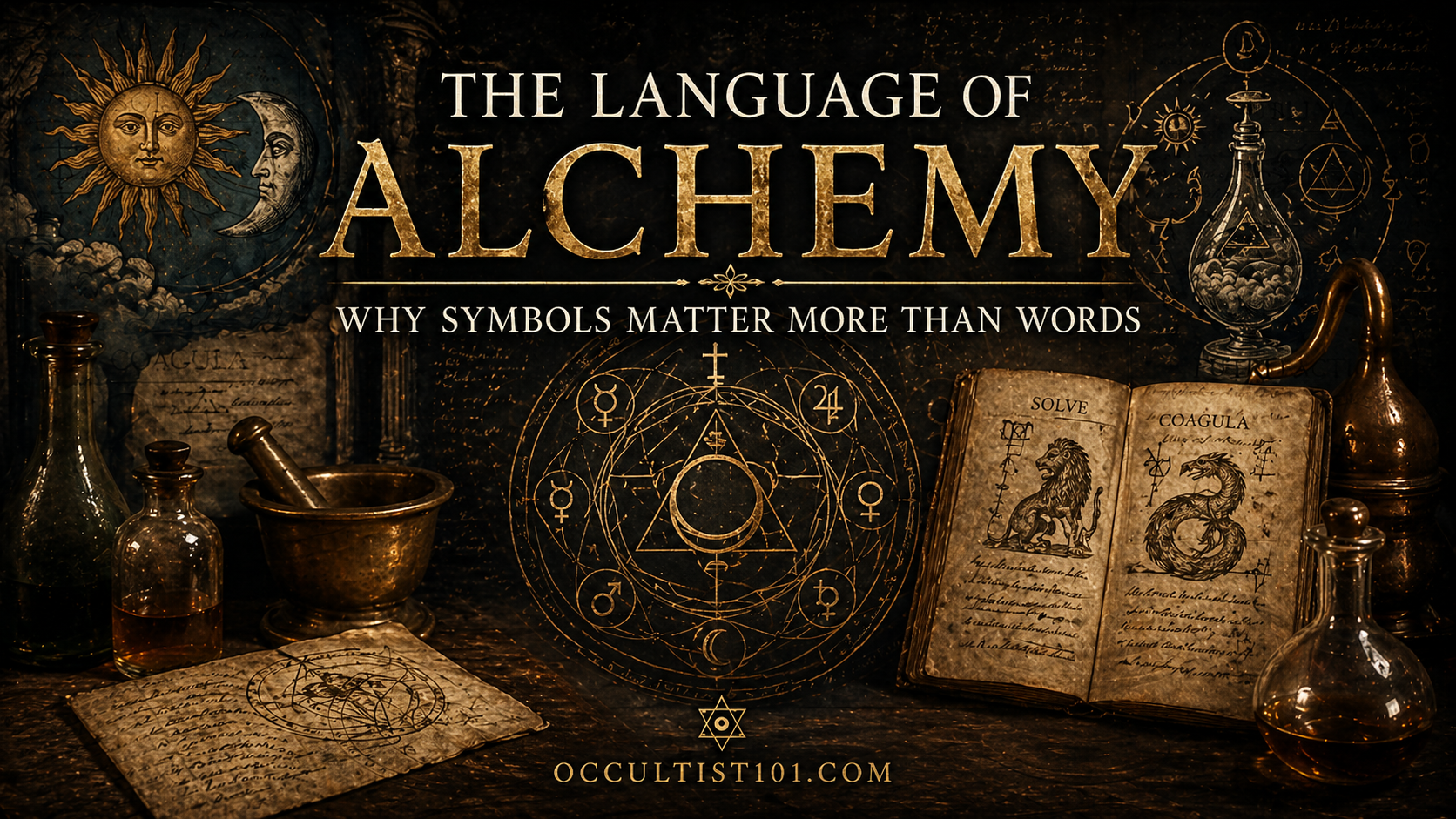
There’s a reason alchemical texts look the way they do — dense with strange glyphs, planetary symbols, coded diagrams, and imagery that seems deliberately impenetrable. That reason isn’t accident, and it isn’t mere decoration. The symbols are the language. And once you understand why alchemists chose symbols over plain speech, the entire tradition opens up in a way that no straightforward explanation ever could.
Words Lie. Symbols Endure.
Medieval and Renaissance alchemists had a problem that any serious esotericist eventually faces: how do you transmit genuine knowledge across time, across languages, across cultures — without it being stolen, corrupted, or destroyed?
Plain text fails this test. It gets translated badly. It gets censored. It gets read literally by people who miss the point entirely. The Church was watching. Rivals were watching. And the knowledge being protected — the inner mechanics of transformation, both material and spiritual — was considered far too valuable to hand over carelessly.
Symbols solved this problem elegantly. A glyph carries meaning on multiple levels simultaneously. It speaks to the trained eye while remaining opaque to the uninitiated. It crosses language barriers. It encodes process, principle, and metaphysical reality in a single mark. And it activates something in the mind of the practitioner that a sentence simply cannot — a direct, non-verbal recognition.
This is why alchemical texts from 12th-century Arabia, 15th-century Germany, and 17th-century England share the same core symbolic vocabulary. The glyphs unified a scattered, secretive tradition across centuries of distance and difference.
The Symbol as Operating System
To understand alchemical symbols properly, you need to shift how you think about them. They are not labels. They are not abbreviations for longer words. They are operational — meaning they describe a process, a relationship, or a principle in a form that the practitioner works with, not just reads about.
Take the circle. In alchemy, a plain circle represents gold, the sun, perfection, and the completed Great Work all at once. That’s not vagueness — that’s compression. The alchemist looking at that symbol understands all of those meanings simultaneously and works with the full weight of them. A sentence saying “gold, which is associated with the sun, which represents perfection” breaks the meaning into pieces. The symbol holds it whole.
This is the deeper reason symbols matter more than words: they preserve the integrity of complex, layered ideas in a way that linear language cannot. Alchemy is a system of correspondences — everything relates to everything else in a web of meaning. Symbols carry that web. Words flatten it.
Mercury: The Symbol of Transformation Itself
Few symbols in the alchemical canon are more central than Mercury — and few are more misunderstood by newcomers.
The glyph for Mercury combines three elemental forms: a circle (spirit), a cross (matter), and a crescent (soul). Stacked vertically, they represent the complete human constitution — and the complete alchemical project. Mercury is the mediator, the fluid principle that moves between opposites and makes transformation possible.
In practical alchemy, Mercury referred to the actual metal — quicksilver — prized for its liquid, shape-shifting nature at room temperature. But the symbol always carried more than the material. Mercury (or Mercurius) was also the spirit of the alchemical work itself: the trickster, the messenger, the substance that could dissolve what seemed fixed and crystallize what seemed formless.
When you see the Mercury glyph in an alchemical text, you’re being told something about the quality of what’s happening — that this stage of the work involves dissolution, mediation, fluidity. It’s not a noun. It’s a description of a dynamic state.
Sulfur: The Principle of Fire and Will
Where Mercury is fluid and mediating, Sulfur is fixed and active. Its glyph — a triangle pointing upward, crossed at the base — speaks immediately to fire, ascent, and masculine force.
In the alchemical trinity (which also includes Salt), Sulfur represents the soul of a substance — its active, energetic, combustible essence. It’s the principle that drives transformation forward. Without Sulfur, nothing changes. Without it, Mercury has nothing to act upon.
Philosophically, Sulfur maps onto will, desire, and the animating force of life. In inner alchemy — the tradition that treats the Great Work as a metaphor for spiritual development — Sulfur is the fire of transformation within the practitioner: the burning away of what’s false, the energy that drives the work even when it’s uncomfortable.
The upward-pointing triangle of Sulfur is not arbitrary. Triangles appear throughout sacred geometry as symbols of dynamic force and directionality. The alchemists chose this form deliberately, encoding the upward aspiration of spiritual work into the shape itself.
The Four Elements: A Map of Reality
Before modern chemistry reorganized our understanding of matter, the four classical elements — Earth, Water, Fire, and Air — served as the fundamental framework for understanding everything that exists. Alchemy inherited and deepened this system, encoding each element in a precise geometric glyph.
Fire △ — An upward triangle. Active, ascending, transformative. The force that refines and purifies.
Water ▽ — A downward triangle. Receptive, descending, dissolving. The force that softens and surrenders.
Air △̶ — An upward triangle with a horizontal line through it. Like Fire, but tempered — active intelligence rather than raw force.
Earth ▽̶ — A downward triangle with a horizontal line. Like Water, but grounded — receptive stability rather than flowing dissolution.
What’s elegant here is the internal logic. Fire and Water are pure opposites — one ascending, one descending. Air and Earth are their mediated forms, the horizontal line indicating that something has been integrated or balanced. The four glyphs together form a complete map of the forces at play in any transformation — including the transformation of a human being.
Alchemists didn’t just write these glyphs in margins. They used them to annotate every stage of a process, indicating which elemental quality was dominant, what needed to be increased or reduced, and what the goal of a given operation was. The symbols were a working notation system as much as a philosophical vocabulary.
Why This Matters for Practice
Reading about alchemical symbols is interesting. Working with them is something else entirely.
When you sit with the Mercury glyph and contemplate its three components — spirit, soul, matter — something happens that no explanation of those three words produces. When you trace the Sulfur triangle and feel its upward insistence, you’re engaging the symbol as the alchemists intended: as a direct transmission of principle.
This is why serious students of alchemy don’t just learn what the symbols mean. They learn to see in symbols — to move through an alchemical text the way a musician moves through a score, reading not just individual notes but the dynamic relationships between them.
That kind of literacy takes time, but it starts with getting the fundamentals right. Having a comprehensive, well-organized reference to the full symbolic vocabulary of alchemy — the metals, the planets, the processes, the elemental glyphs — is the foundation everything else is built on.
The Language of Symbols: Alchemical Glyphs Decoded is exactly that foundation. It covers 50+ alchemical symbols across metals, planets, and processes in a visual reference format built for both study and active use at the altar or workbench. At $12, it’s the most direct way to start reading alchemy the way alchemists actually wrote it.
The Worldview Behind the Symbols
Zoom out from the individual glyphs and a coherent picture emerges. The alchemical symbol system rests on a single foundational idea: that the universe is a unified web of correspondences, and that everything in creation reflects everything else.
Gold corresponds to the Sun corresponds to the heart corresponds to the color yellow corresponds to the number six. These aren’t poetic associations — to the alchemist, they were structural realities, the load-bearing architecture of the cosmos. The symbols encode these correspondences in compact form, allowing the practitioner to navigate the web consciously.
This is also why alchemy was never purely a material science, despite involving real furnaces, real crucibles, and real chemical processes. The outer work and the inner work were always simultaneous. Refining a metal meant refining the self. Dissolving a compound meant dissolving a fixed belief. The symbols held both meanings at once — which is precisely what made them the right language for the work.
If you’re new to alchemy and want to understand the full scope of the tradition before diving into the symbols — the history, the four elements, the Great Work, the key terminology — Alchemy for Beginners gives you that complete foundation for $9. It’s the ideal companion to the Glyphs guide, giving context to every symbol you’ll encounter.
Begin Reading the Hidden Language
The alchemists built a language that has lasted nearly a thousand years. It survived the Inquisition, the Scientific Revolution, and every cultural shift that should have rendered it obsolete — because it describes something real about transformation that plain language still hasn’t found a better way to say.
Learning that language is one of the most rewarding things a student of the occult can do. It doesn’t just unlock alchemical texts — it trains a way of seeing that carries into every other esoteric system you’ll ever study.
Start with the symbols. Let them work on you. The meaning will follow.