Ask most people what alchemy is and you’ll get one of two answers. Either it’s the medieval pseudoscience where confused men in robes tried to turn lead into gold before chemistry sorted everything out — or it’s the mystical self-help metaphor that modern spirituality borrowed and stretched into something unrecognizable.
Both answers miss the point entirely.
Alchemy is one of the most sophisticated and complete systems of transformation ever developed. It operates on multiple levels simultaneously — material, psychological, and spiritual — and its central concept, the Great Work, is as relevant today as it was in 12th-century Alexandria. Understanding what the Great Work actually means changes how you see not just alchemy, but the entire Western esoteric tradition.
The Myth: Lead Into Gold
Let’s start with what alchemy is not — or rather, what it is not only.
Yes, historical alchemists worked with physical materials. They had furnaces, crucibles, bellows, and flasks. They heated, dissolved, filtered, and recombined substances in ways that would eventually give birth to modern chemistry. Some of them genuinely believed they could transmute base metals into gold by discovering the Philosopher’s Stone — a legendary substance said to perfect whatever it touched.
But here’s what the reductive version of history leaves out: the serious alchemists always knew the material work and the spiritual work were the same work. The furnace outside reflected the furnace within. The lead being refined was also the leaden parts of the self — the dense, unconscious, reactive patterns that weigh a person down. The gold being sought was also the realized, luminous self that emerges when those patterns are burned away.
This wasn’t metaphor grafted onto chemistry after the fact. It was the original design. The alchemical texts that have survived are layered with both meanings simultaneously, deliberately. The physical and the philosophical cannot be separated in authentic alchemy — and the Great Work is the name for the entire process of transformation, on every level at once.
What Is the Magnum Opus?
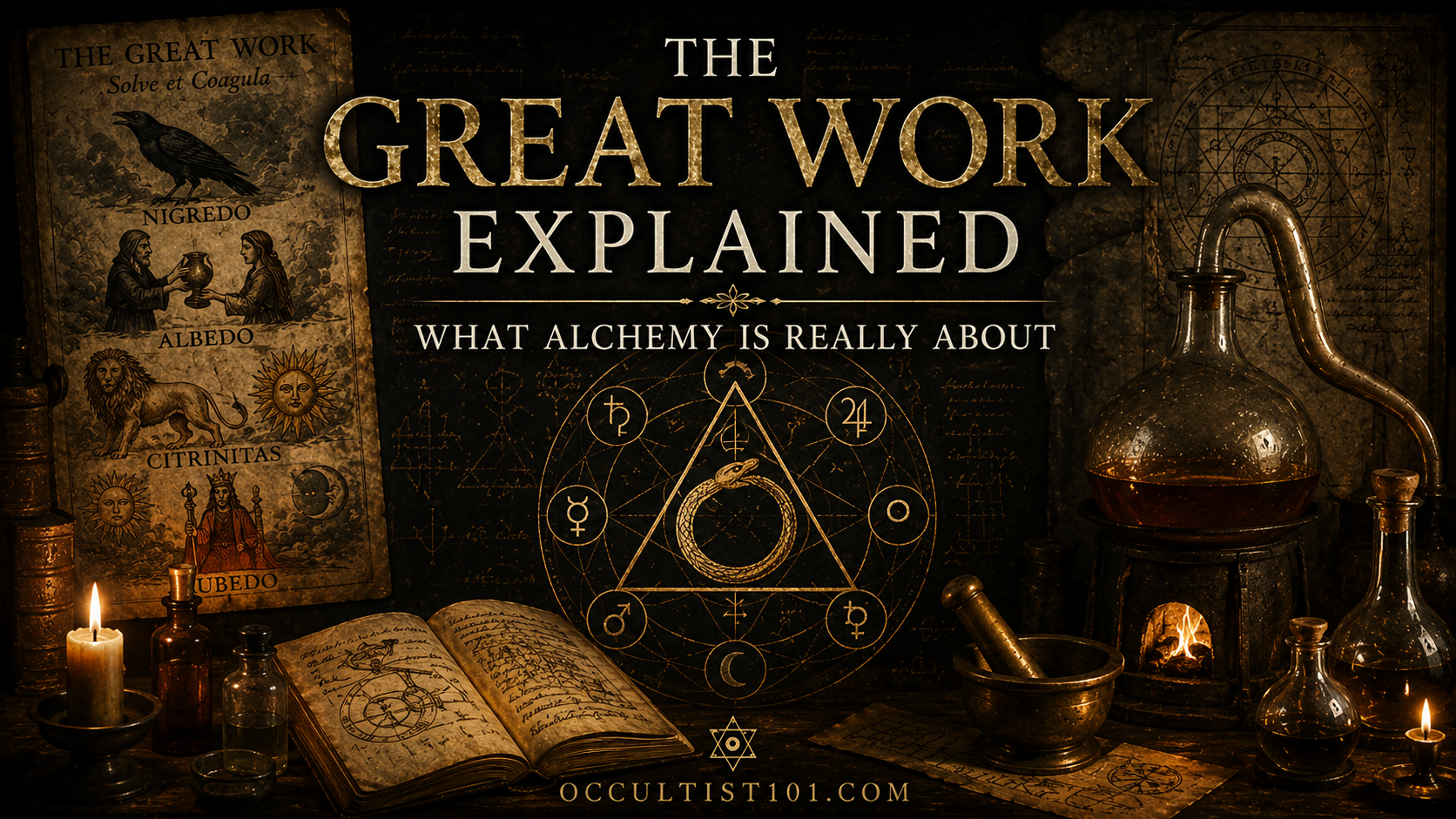
Magnum Opus is Latin for Great Work. In alchemical tradition, it refers to the complete process of creating the Philosopher’s Stone — the agent of perfect transformation. But understanding what that actually means requires understanding the four classical stages the work moves through.
These stages are traditionally represented by colors, each marking a distinct phase of transformation:
Nigredo — The Blackening
The Great Work begins in darkness. Nigredo is the stage of dissolution, putrefaction, and confrontation with everything that must be broken down before something new can emerge. In the laboratory, it was the charring and decomposition of the prima materia — the raw starting material of the work. In the inner life, it corresponds to what we might now call the dark night of the soul: the collapse of illusions, the confrontation with shadow, the breaking apart of the false self.
This is the stage most people want to skip. It’s uncomfortable, disorienting, and looks from the outside like failure or regression. The alchemists insisted it was not only necessary but the essential beginning. Nothing genuine is built on unexamined foundations. The blackening clears the ground.
Albedo — The Whitening
After the darkness comes purification. Albedo is the washing stage — the separation of what is pure from what has been burned away. The substance that survives Nigredo is cleansed, refined, clarified. In inner terms, this is the emergence of a clearer self-awareness after the initial dissolution: a quieter mind, a more honest relationship with one’s own nature, the beginning of genuine discernment.
Albedo is associated with the moon, with silver, with the reflective quality of consciousness that learns to witness itself without judgment. It’s a stage of increasing clarity — not yet completed, but no longer lost in the initial darkness.
Citrinitas — The Yellowing
Citrinitas is the transitional stage, sometimes omitted in later alchemical systems that compress the work into three phases. It represents the dawn — the first light of solar consciousness breaking through. The practitioner at this stage is moving from purified awareness into active, embodied wisdom. The inner gold is beginning to appear, but has not yet fully stabilized.
Rubedo — The Reddening
The final stage. Rubedo is the completion of the Great Work — the full integration of what has been transformed. The Philosopher’s Stone is achieved. In the laboratory, this was the production of the red tincture capable of transmuting metals. In the inner life, it represents the fully realized human being: someone who has integrated their shadow, purified their awareness, and embodied genuine wisdom and will.
Rubedo is associated with the sun, with gold, with the marriage of opposites — the union of the solar masculine and lunar feminine principles within a single integrated consciousness. It is not a final destination so much as a new quality of being from which the practitioner continues to operate in the world.
The Philosopher’s Stone: What It Really Is
The Philosopher’s Stone is the most famous symbol in all of alchemy, and the most misunderstood. In popular culture it’s a literal rock that grants immortality and turns metals into gold. In authentic alchemical tradition it’s something considerably more interesting.
The Stone is the product of the Great Work — the perfected substance, the agent of transformation. It doesn’t just change metals; it perfects whatever it touches, bringing each thing to its highest potential expression. In spiritual terms, the Stone is the realized self: the consciousness that has passed through Nigredo, Albedo, and Rubedo and emerged integrated, clear, and genuinely free.
Some traditions describe the Stone as a state of being more than a thing. You don’t find it or make it in the conventional sense — you become it, through the Work. This is why genuine alchemical texts are so careful to say that the prima materia — the raw starting material from which the Stone is made — is everywhere, available to everyone, and yet almost no one recognizes it. Because the prima materia is the practitioner themselves. You are both the laboratory and the material being transformed.
Inner and Outer: Why Both Matter
One of the persistent misreadings of alchemy — especially in modern spiritual circles — is to dismiss the material dimension entirely and treat the whole tradition as psychological metaphor. Carl Jung did important work connecting alchemical symbolism to the unconscious, but his framework is a psychological lens, not the complete picture.
The serious alchemical traditions held that the inner and outer dimensions of the work were genuinely connected — not just symbolically parallel. Working with physical substances in a state of conscious intention was understood to have real effects on both the substance and the practitioner. The laboratory was a sacred space. The operations were ritual acts as much as chemical processes.
This is why understanding alchemy properly requires engaging with both dimensions: the history and philosophy of the tradition, and the symbolic and practical language it operates in. Skipping either one produces a distorted picture.
If you’re just beginning to explore alchemy and want a clear, structured introduction to the history, the four elements, the Great Work, and the key terminology — Alchemy for Beginners is exactly the guide you need. It’s a complete digital guide designed to give new students a genuine foundation without oversimplifying the tradition — available for $9.
The Symbols Are the System
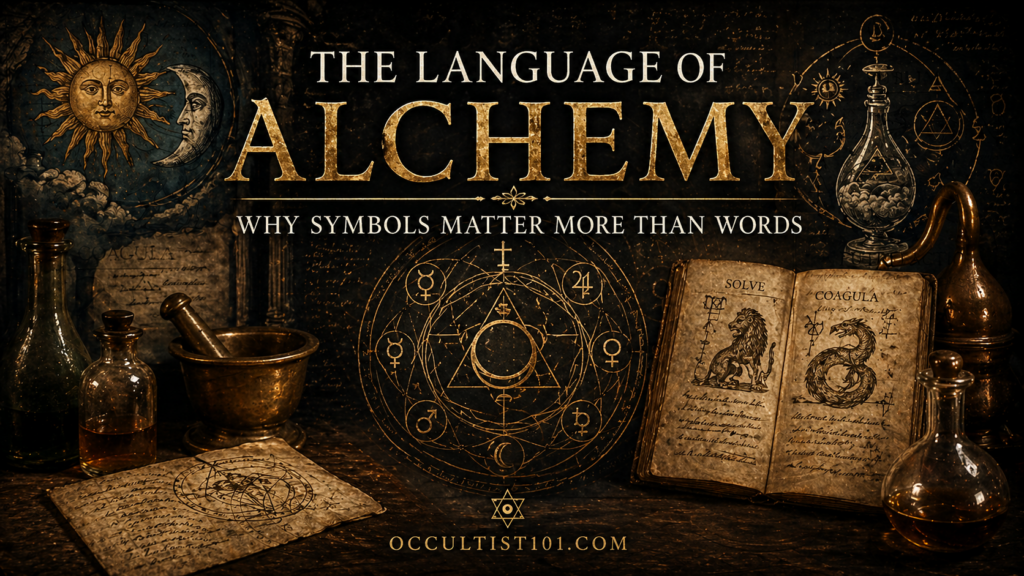
You cannot go far in alchemy without encountering its symbolic language — the glyphs for metals, planets, elements, and processes that alchemists used to encode their knowledge across centuries. These symbols are not decorative. They are the operating language of the tradition.
Mercury, Sulfur, and Salt — the alchemical trinity — each have precise glyphs that encode their philosophical meaning in visual form. The four elements each carry geometric symbols whose logic is internally consistent and deliberately chosen. The planetary metals — gold for the Sun, silver for the Moon, iron for Mars, and so on — form a correspondence system that connects earthly materials to cosmic principles.
Learning to read these symbols is what separates someone who has read about alchemy from someone who can actually navigate the tradition. It’s a learnable skill, and having a comprehensive visual reference makes the process dramatically more efficient.
The Language of Symbols: Alchemical Glyphs Decoded covers 50+ alchemical symbols across metals, planets, and processes in a clear visual format built for active use. If the Great Work is the journey, this guide is the map you carry with you — available for $12.
Why the Great Work Still Matters
Alchemy as a laboratory practice gave way to chemistry in the 18th century. But the Great Work — as a framework for understanding transformation — never became obsolete, because the thing it describes never changed.
The process of confronting what is dense and false within yourself, purifying it, and integrating something more genuine and luminous in its place is not a medieval concern. It is the central challenge of any conscious human life. Alchemy simply gave it a precise language, a structured process, and a symbolic vocabulary powerful enough to hold the full complexity of what transformation actually involves.
That’s why people keep returning to it. Not because they want to make gold — though the tradition has plenty to say about prosperity and material transformation too — but because the Great Work describes something they recognize in their own experience: the sense that something in them is being refined, that difficulty serves a purpose, that the darkness is a stage and not a destination.
The Magnum Opus is not a historical curiosity. It is a living map.
Where to Begin
If alchemy is calling to you, the entry point is simpler than the tradition’s reputation suggests. You don’t need a laboratory or a decade of Latin scholarship. You need a clear understanding of the foundational concepts — and the patience to let the work unfold at its own pace.
Start with the history and philosophy. Understand what the four stages mean, what the four elements represent, and what the Great Work is actually asking of the practitioner. Then move into the symbolic language — the glyphs that encode the tradition’s deepest principles in visual form.
Both of those starting points are waiting for you:
- Alchemy for Beginners — History, four elements, the Great Work, and key terminology. The complete conceptual foundation. ($9)
- Alchemical Glyphs Decoded — 50+ symbols across metals, planets, and processes. The visual language of the tradition. ($12)
The Great Work begins the moment you decide to take your own transformation seriously.
That moment can be now.
Occultist101 — The Hidden System of Modern Occult Practice